Starting the Day
 My second day in Krakow began with a slow wander down to breakfast. It was typical hotel fare, but it did the job. It offered the usual suspects: scrambled eggs that looked like they’d been through something emotionally. Pale sausages that were most definitely not English in design. Crispy streaky bacon. All good. The glasses for fruit juice were more like thimbles though. And it took me some time to find butter. Oh! And I couldn’t figure out the whole yoghurt and fruit scenario.
The weather was warm but cloudy. There were clouds hanging around like they’d got something in mind, but couldn’t quite be bothered with it yet. I left the hotel at 10am with eight hours to fill before my caching event in the main square. The plan was simple: zig around the old town and find as many caches as possible. Saturday had been a mixed bag, so I was hoping for fewer DNFs. With that in mind, I headed south towards the castle before looping back around the east side. It felt like a good day to get things done.
Circling the Centre
The Krakow’s Old Town is a compact maze of cobbles, churches and grand squares. It sits inside the ring of Planty Park, a four‑kilometre green belt built on the site of the medieval defensive walls. The park was created in the early nineteenth century after the old fortifications were dismantled, and it now forms a chain of thirty small gardens dotted with monuments and fountains. The Planty is popular with locals, who treat it as a scenic walkway around the historic centre. It’s easy to see why. The trees offer shade, the benches are well placed, and the whole ring feels like a natural boundary between old and new.
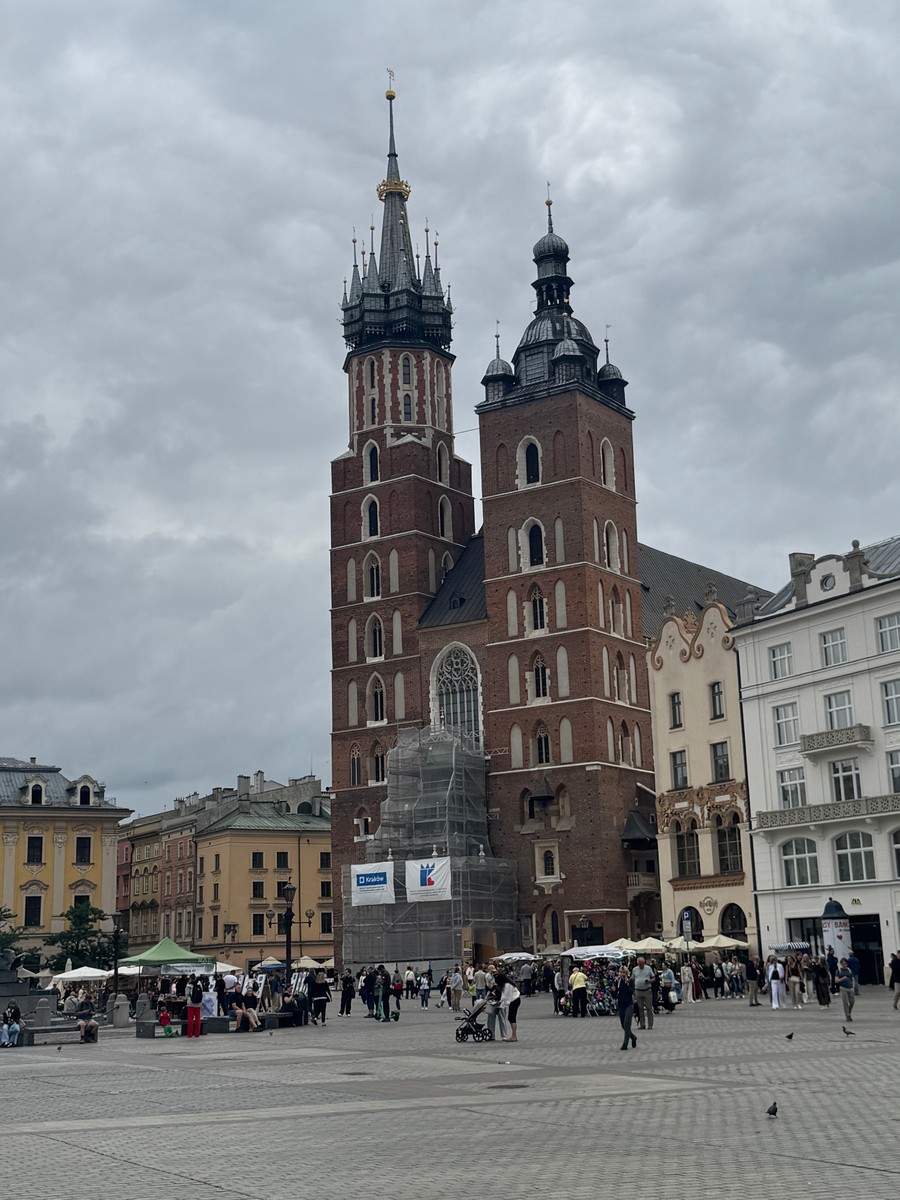
Inside that ring is the UNESCO‑listed old town, one of Europe’s best‑preserved medieval centres. The layout dates from 1257, when the city was rebuilt after Mongol invasions. The Main Market Square sits at its heart. It’s the largest medieval square in Europe and is surrounded by Gothic, Renaissance and Baroque architecture. St. Mary’s Basilica dominates one corner with its uneven towers, while the Cloth Hall stands proudly in the centre. The Royal Road runs through the district and is the subject of a wherigo cache. It begins at the Barbican and Florian Gate and heads down towards Wawel Castle.
 Walking here feels like stepping through layers of history. The streets follow the thirteenth‑century grid. The churches span several architectural periods. The square is lively, but the side streets are calm. It’s a place where you can wander without a plan and still feel like you’ve seen something important. On a warm, sunny day, whilst engaged in some geocaching, it’s easy to lose track of time. And I did. The old town rewards slow progress, and I was happy to zig and zag my way through it whilst tackling the day’s caches.
Hidden Tasks
The standout geocaches of the day was a series of letterbox caches placed at several branches of the National Museum. There are five or six of them, each involving a field puzzle or onsite task. The museum staff knew about the caches and were happy to help when I was struggling. One cache began with a QR code that gave instructions for entering the museum. It then provided a second QR code that opened a locker in the baggage room. Another required collecting numbers from a couple of old relics and using them to calculate a new location. That led me to an old bicycle with a lockable tin in its front basket. A third had clear instructions and ended at a framed picture with a detachable side panel. They were clever, well planned and easily earned favourite points. The only downside is that they are only accessible during museum opening hours (clearly), which means before 4pm. The museum staff were, however, fully clued up and generally helpful, in that ‘oh, you’re one of those?’ sort of way.
Blocked Paths
 The central square is home to a significant number of adventure labs, and I’d translated all of them into English before setting off. Most were straightforward, but one series was sequential, and that is where the trouble began.
Half the square had been fenced off with metal railings, enclosing a vast sheet of protective plastic flooring that looked suspiciously like an alien landing zone. Apparently it was an event from the World Speed Climbing Championships or something. As well as the plastic flooring, there was a massive climbing wall. Only competitors were allowed inside, which added to the sense that something otherworldly was going on. Even the pigeons were keeping clear. The second and third stages of the lab were directly underneath this protective veneer, sealed away in an impenetrable fortress guarded by a crack platoon wearing baseball caps and black bomber jackets. I wasn’t going to get that set of labs finished today.
So I spent the rest of the afternoon zigging and zagging around the old town, picking off as many caches and lab stages as possible. By the end of the day I’d made 69 finds, including 48 lab stages. It was a productive day, and much better than Saturday.
A Quiet Gathering
My caching event in the square was scheduled for 6pm, and for the first fifteen minutes it was just me and someone on the same bench who was smoking a tobacco product so pungent it could probably have signed the log on its own. You get used to that not happening in the UK, so the experience felt both nostalgic and repulsive at the same time. Eventually one Polish cacher arrived. He didn’t speak much English, and my Polish extends only as far as pointing at things and hoping the other person understands the gesture. I can usually muddle through in Scandinavia, Benelux or France with a mix of guesswork and misplaced confidence, but Kraków was having none of it.
So we exchanged a few valiant but mutually baffled sentences before the rain arrived. When I say “arrived” I mean “descended”, at a great rate. It didn’t drift in gently. “Leje jak z cebra” as they say in Poland, which is what Google translate came up with when I typed in “it’s coming down like stair rods.”
While getting soaked, we spotted two more cachers hiding under cover. We wandered over and attempted conversation, which went slightly better because one spoke good English. After ten minutes of damp conversation, everyone had to be somewhere else. I stayed at the event location until after the official finish time, if only because the sun had returned. Nobody else appeared. I did, however, learn a useful lesson: buy a postcard and use it as a logbook for future “MKGees on Tour” events. It’s simple, portable, and doesn’t require any linguistic compatibility whatsoever.
Stormy Supper
A running friend had recommended I try Sioux for dinner. It was actually the closest restaurant to where I’d placed the caching event (totally by accident). So I settled outside with a beer and a burger that looked ready to deliver spiritual fulfilment. It barely had time to introduce itself before the rain returned even more angrily than before. I had to move seats to stop my dinner being washed away, and the burger took the whole ordeal rather stoically. I guess it had no preference over whether its ultimate demise would be caused by chewing or drowning.
When the rain finally gave up, I walked back to the hotel. I had an early start, so I went straight to bed and missed England vs Mexico in the World Cup. Reports suggest I missed a thriller. Not the Michael Jackson sort though. England progressed, at the cost of several bookings and one sending off.