Starting the Day
 I’d arranged a trip out to the former concentration camps at Auschwitz and Birkenau. It’s about an hour outside Kraków, and not, to be honest, a day I was looking forward to. It felt like something that had to be done. Something everyone should do. But not something to feel positive about.
My minibus pickup was scheduled for 7:40am, but the driver texted beforehand and arrived ten minutes early. We made two more stops in town, collecting three other British tourists. That seemed about right for an English‑language tour. The drive out was smooth.
I wasn’t familiar with the layout of the site, so I was surprised when the car park at Auschwitz turned out to be modern steel and glass, with neat planting and a busy flow of visitors. It felt like a strange contemporary gateway to a place haunted by its past. We mooched around for a bit to allow a toilet break and to wait for our guide. Our tour was scheduled to start at 9:50.
Auschwitz
The tour took us through several buildings. Some had been cleared out and modernised to host museum exhibits. Others had been left much as they were, so you could see to some extent what the living conditions had been like. The first thing I learned was that Auschwitz itself was primarily a concentration camp. It wasn’t an extermination site, except for one building where the Nazis tested the gas chamber process. The inmates here were Jews, but also Roma, Russian POWs, Polish political prisoners, homosexuals, and anyone else the Nazis weren’t keen on. Which, frankly, was anyone who didn’t brown‑nose Hitler fast enough or for long enough.
One display was just shoes found during liberation. There were thousands of them. Another room was filled with suitcases, each labelled in white paint with the name, town of origin and date of birth of the owner. This maintained the illusion that the arrivees were being resettled rather than slaughtered. They were, of course, mostly slaughtered, and the Nazis removed anything of value from both their luggage and their bodies. “Horrific” doesn’t even begin to cover it.
 Those who were sent to work in the camp rather than directly to be killed were subjected to brutality, overwork, insanitary conditions, starvation and humiliation at every opportunity. The worst of the cruelty was, unbelievably, committed by prisoners enlisted as guards in exchange for access to washing facilities and half an extra bowl of gruel each day. What the actual?
Commentary
The tour lasted a couple of hours. The guide was difficult to follow because the headsets were garbled and had a half‑second delay from her real speech. I spent most of the time either trying to get close enough to hear or wondering which of the many concurrent tour groups I belonged to. That part wasn’t great. It also went a bit too fast, and didn’t allow enough time to read all of the information boards.
Birkenau
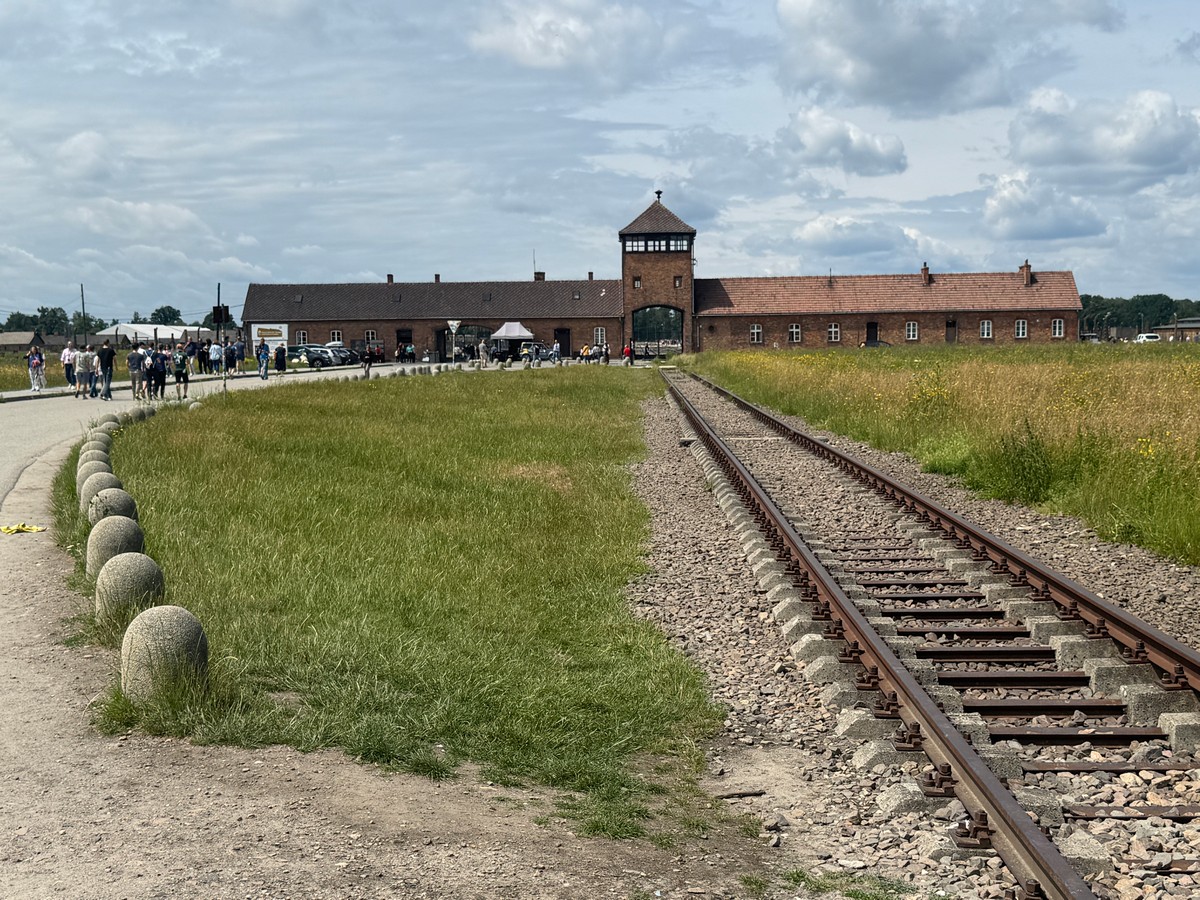
After a short break we boarded the minibus again and travelled the kilometre to Birkenau — the extermination camp. This is the location of the famous photo of the entry gate with the railway running through it. Most such photos are taken from inside the camp looking outwards, because there are fewer visual distractions.
What struck me immediately was the sheer scale. Birkenau is an order of magnitude larger than Auschwitz. It stretches further than you can see. Over a million people were murdered here, most of them non‑combatants. Anyone arriving with an ounce of muscle was sent to Auschwitz to be worked to death. Those too old, young, weak or sick were killed immediately. Many never spent a night here. They got off a train, were sorted, stripped, robbed and killed.
 Whatever drives a human being to do that to another is beyond my comprehension. And I am greatly disturbed by the apparent re‑emergence of such attitudes in Europe and the Americas. We do not learn. We pander to similar ideas in the name of “free speech”, and I am a firm believer that free speech cannot be free of consequences. Some ideas are too abhorrent to humanity to be given oxygen. The Polish Government, much like the French, has made a crime out of holocaust denial.
The guided tour at Birkenau was brief — a walk from the gate along a kilometre of railway line to the ruins of the gas chambers, then a short visit to one of the surviving buildings where a few souls spent a little time before being killed. Then we walked back without our guide. The driver was waiting in the car park.
Summary
I’m glad I went, even though I wouldn’t say I enjoyed it. It was upsetting all round. The organised tour was too quick, in my opinion, and didn’t allow full understanding. If I go again, I’ll take myself there rather than have a guide.
Back to Kraków
I didn’t see any point in sitting in the minibus for an extra half‑hour of drop‑offs around the Old Town. I’d been the first pickup and would be the last drop‑off. So instead I hopped out at the first opportunity and walked a bit of the Old Town to complete a couple more caches. While I was there I grabbed dinner at a pasta place on the north side of the Square. The labs under the climbing arena were still inaccessible.
Back at the hotel I planned to stay up for Spain vs Portugal, but when I switched the TV on I promptly fell asleep. I’d set an alarm for USA vs Belgium but ignored it for most of an hour. When I finally turned the TV back on it was the start of the second half, and I watched the supposedly “past it” Belgian team give USA a thorough schooling in tournament football. At least it meant the debacle over the rescinded red card became irrelevant.